
WELCOMING with Tony Bacigalupo
Norwalk, Connecticut’s Tony Bacigalupo on “New in Town Meetups” and resurrecting the club directory
Welcome to JOIN 101’s first installment of “What are you doing alone that you could be doing together?” — a series highlighting civic innovators we’ve encountered on JOIN OR DIE’s community screening tour who have asked themselves this pivotal question…and put their answers into action.
This week, Tony Bacigalupo shares his journey of deciding to turn welcoming new neighbors into a collective effort by resurrecting the local club directory (in print!) and starting a “New in Town” IRL meetup in Norwalk, Connecticut.
You can listen to Tony’s story above and find the full transcript and helpful resources below. If you or someone you know is ready to follow Norwalk’s example of welcoming neighbors together — share this story…and let us know what you create!
Onward to the next American joining revolution,
Rebecca Davis and Pete Davis
Rebecca: Today we meet Tony Bacigalupo, who a few years ago, was new in town.
Tony: I had moved with my wife to Norwalk, Connecticut and we didn’t know anybody here. We knew some places we wanted to check out, we knew some groups that were around, but I knew that this was gonna be a place that we were gonna really try to settle into, which meant I really needed to get to know what was going on. And, to Norwalk’s credit, they have VisitNorwalk.com, which has a great directory of upcoming events, and you know there’s a lot of great resources that are here. But there was a lot of stuff that I found that just required a lot of digging.
Pete: Now here’s where Tony decided to do something that he could have done alone…together.
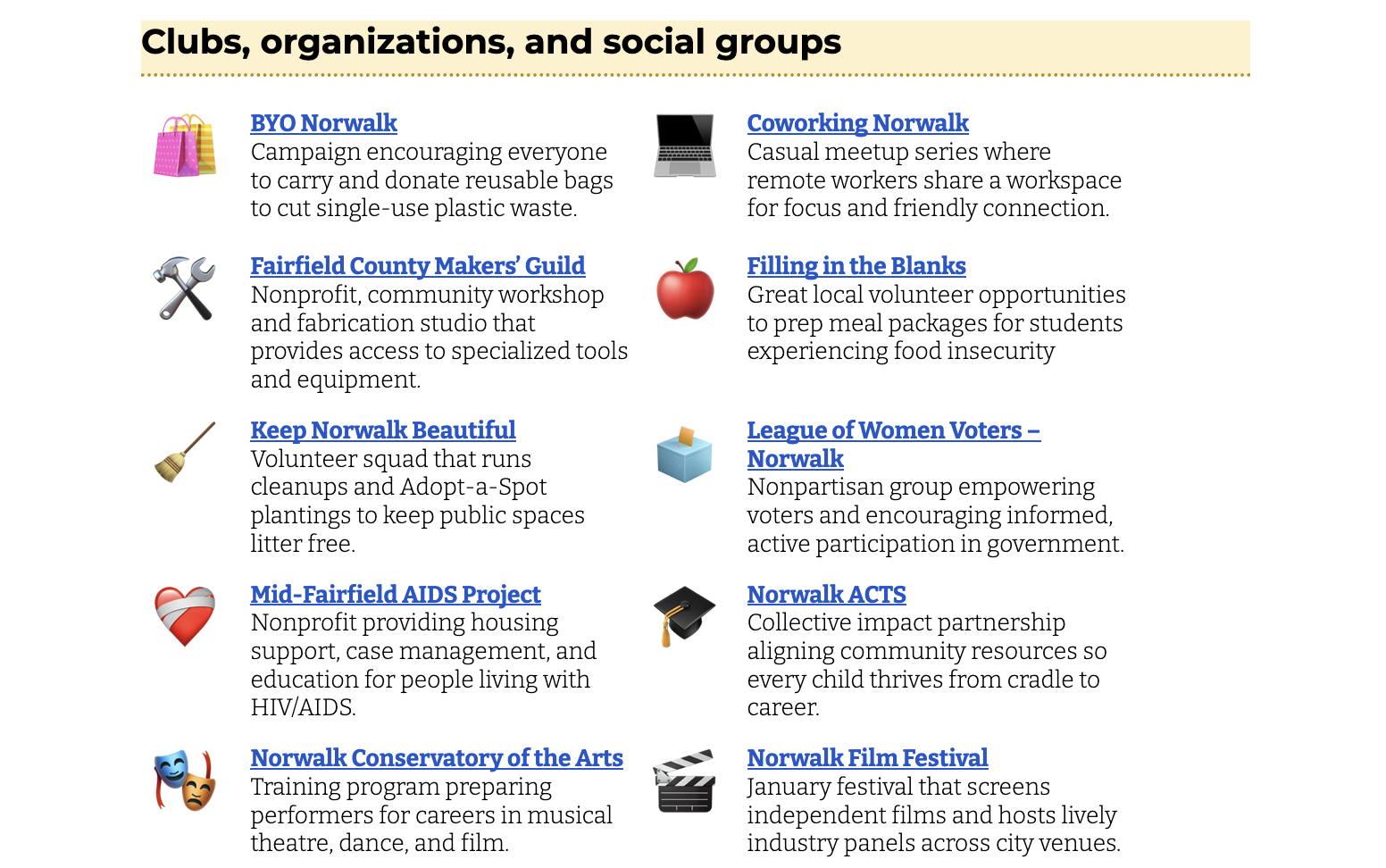
Tony: So, I just started building my own Google Doc of everything I found — all the accounts you should follow on Instagram, the newsletters that provide the most valuable information…all that stuff. And, I had nurtured an idea for a long time of doing what I called the “New to Town Meetup,” specifically for people who want to find out what’s going on, and get them connected.
And so, I was someone who was new to town and I ended up talking with some folks from the city and they were on board to support it. And so I hosted it at my local favorite community cafe and, in order to facilitate that conversation, I turned my personal Google Doc into a shared directory that other people could add to, and it was publicly accessible. And so, the germination of it was just: I needed to create it for myself and then when I did an event where I knew other people were gonna need it, I started sharing it with them.
Rebecca: To take his city directory to the next level, Tony went analog.
Tony: Paper is so underrated in this day and age. Those folks that I worked with, Sabrina and Anna in the city—they offered me a chance to table at an upcoming fair. I said, “I’ll do it, but I need a favor from you: Can you professionally print a version of my directory so I can hand it out to people?”
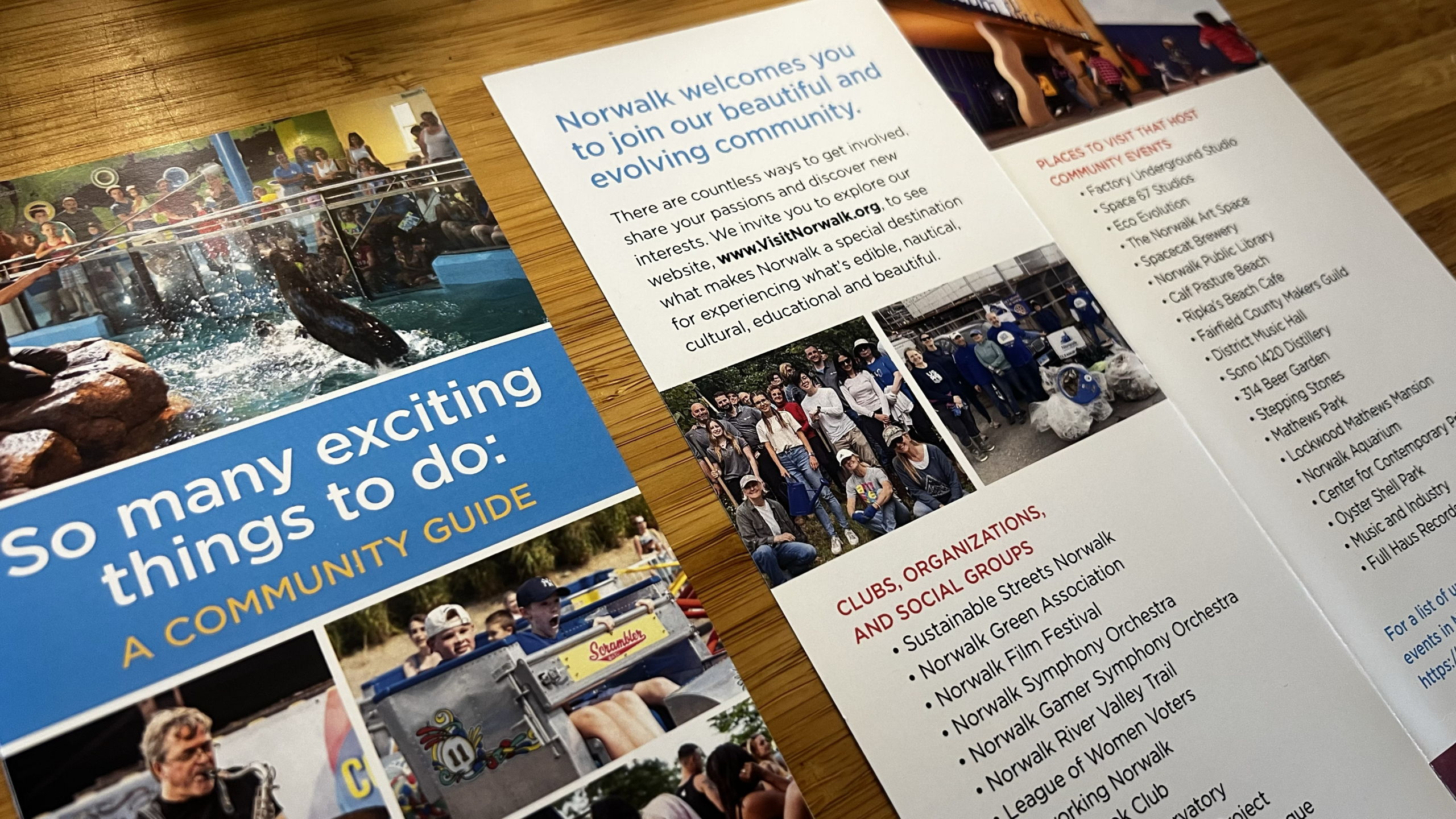
Knowing that my dream scenario was to have the resurrected Norwalk City Directory concept. They printed five hundred of them and I had a stack of them that I gave to the mayor, and the council people, and passers-by. And I just loved being able to hand somebody something and say: “Look, this is everything going on in town—go find something to do.” And, really, it hearkens back to having seen those directories in JOIN OR DIE.
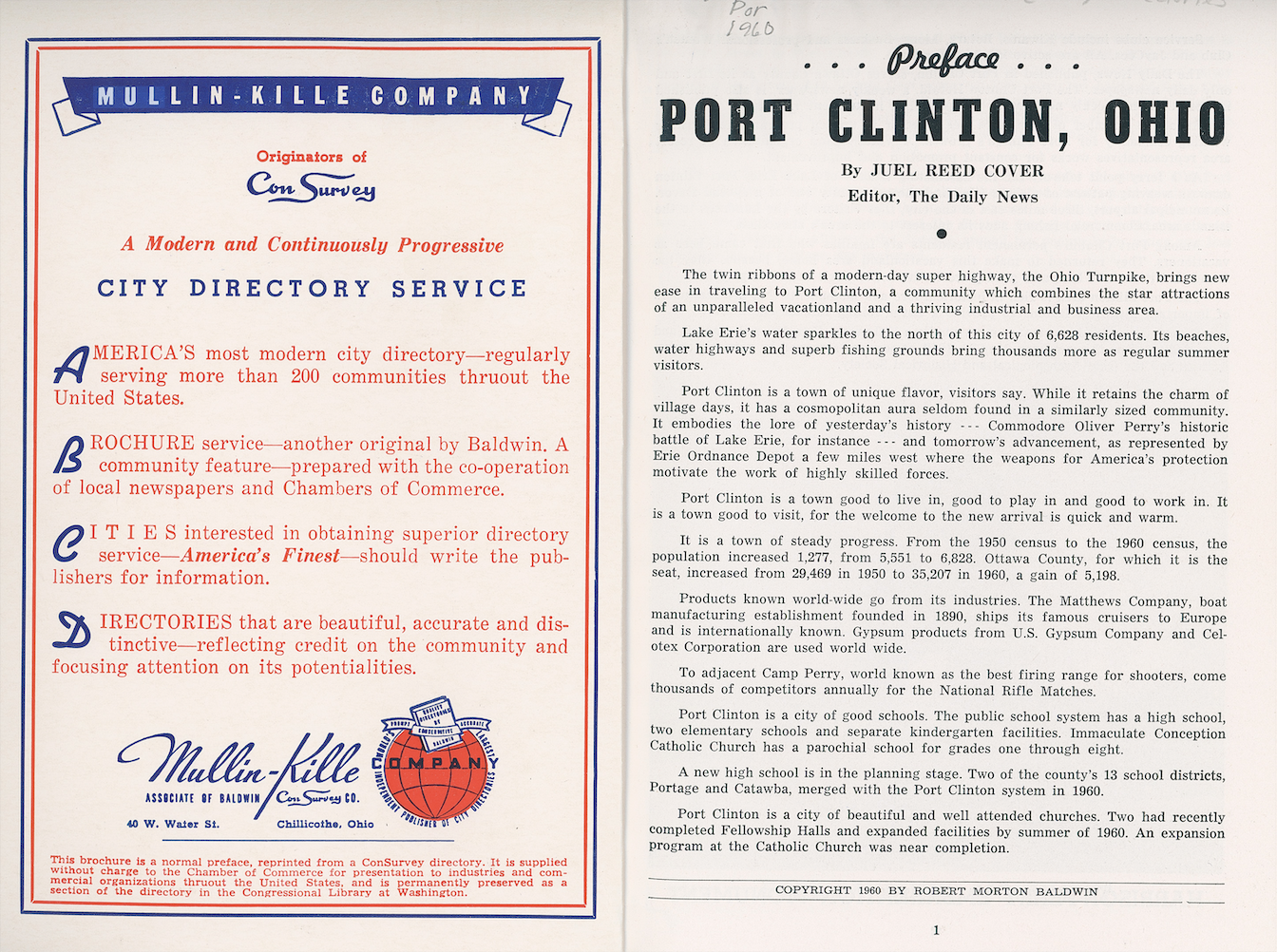
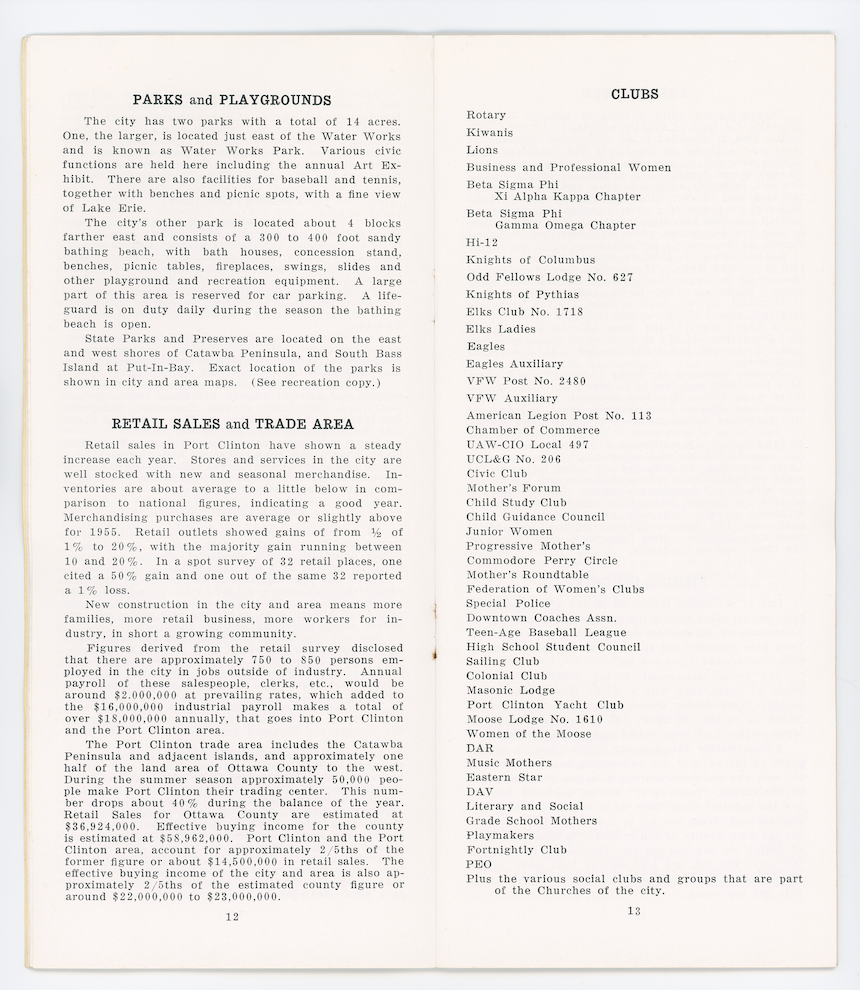
It made me think: There’s no reason why we can’t bring that back. I can do that. I have the power to do that for Norwalk. You know, it takes a little bit of work, but it’s not that hard—and now we have a valuable asset that might help get people out of the house.
It’s still never complete. I’m finding new stuff all the time. I mean: I’ll go to a local fair and I’ll just go around and talk to people and pick up flyers and business cards, just subscribing to every newsletter I can find. I’ll follow, like, “Norwalk Events” on Instagram. Honestly, looking at flyers up in the library or in the local cafe, I find out about a lot of cool stuff going on. So it’s a piecemeal thing.
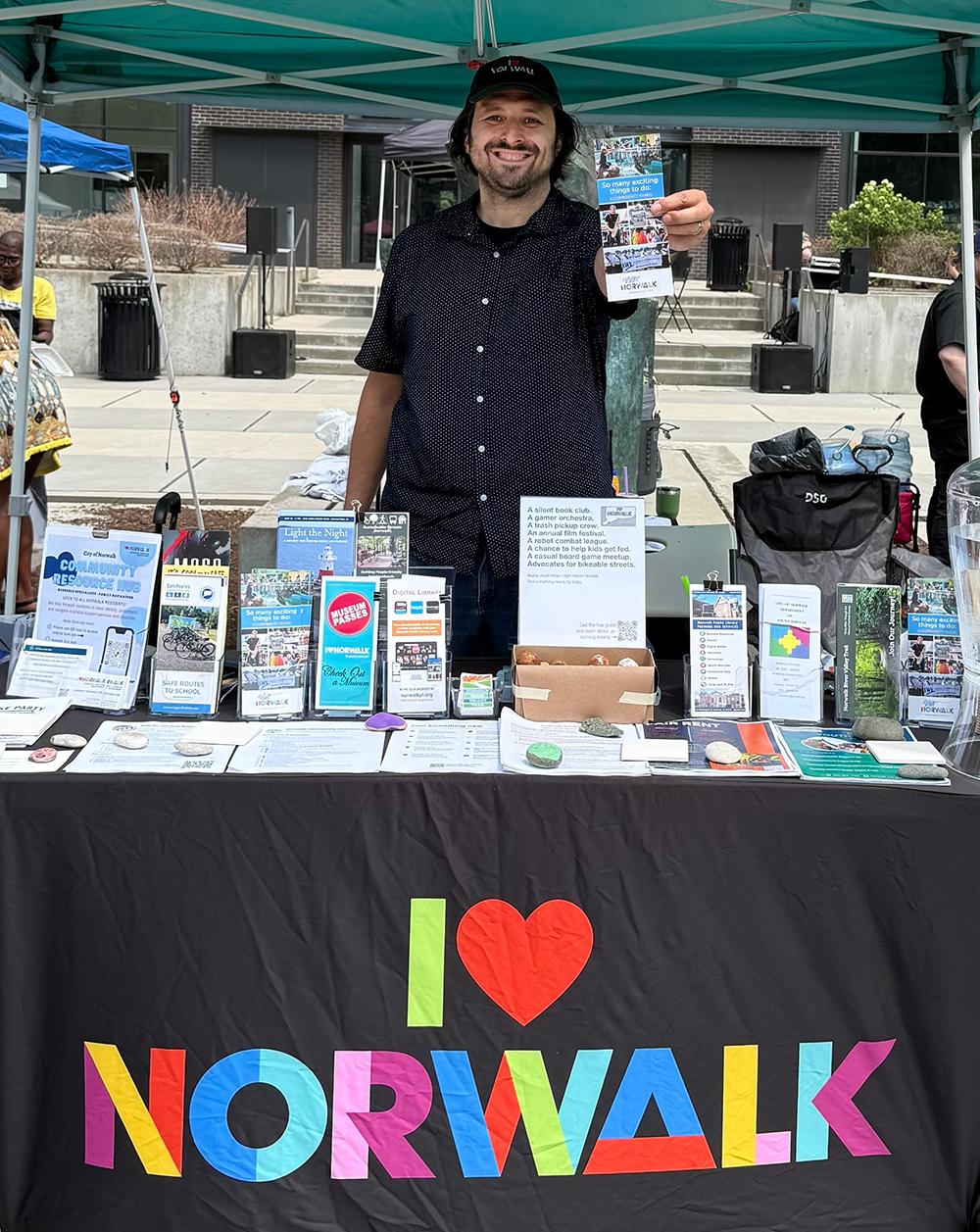
Rebecca: And Tony wants the Norwalk city directory to go beyond just clubs and events.
Tony: It’s, you know: How does this city work? When do the meetings happen where decisions get made? Where are there departments and resources that have cool stuff to offer that we don’t know about? I mean, there’s the whole Community Services Department where they send out an email once a week with resources for children, resources for food scarcity, you know, get your flu shot, all this stuff. And it’s like: If you don’t know that that email gets sent out every week—probably 94% of Norwalk has no clue that that department even exists—you know what I mean? So there’s a lot of awareness building to be done just in terms of what this city even has to offer.
I spent an afternoon where I just wandered city hall and I literally walked into every room just to be like: “What are you guys doing?”
Norwalk has boards and commissions, so if you care about bikes in Norwalk, there’s the Bike/Walk Commission and it has two vacancies. Let’s try to make that as visible as humanly possible. We’re trying to lower that barrier to civic participation, to government participation.
In addition to having it in my directory, I had a packet on my table that was the index of all the boards and commissions, and highlighted which ones had vacancies. So someone wandering by in the Saturday market is going home with a bouquet of flowers, and a gift for their friend, a literal printed packet of the boards and commissions, and a QR code to go find the info.
So I just think it’s part of what we’re trying to do, to know that government exists, and it’s doing stuff, and it’s us.
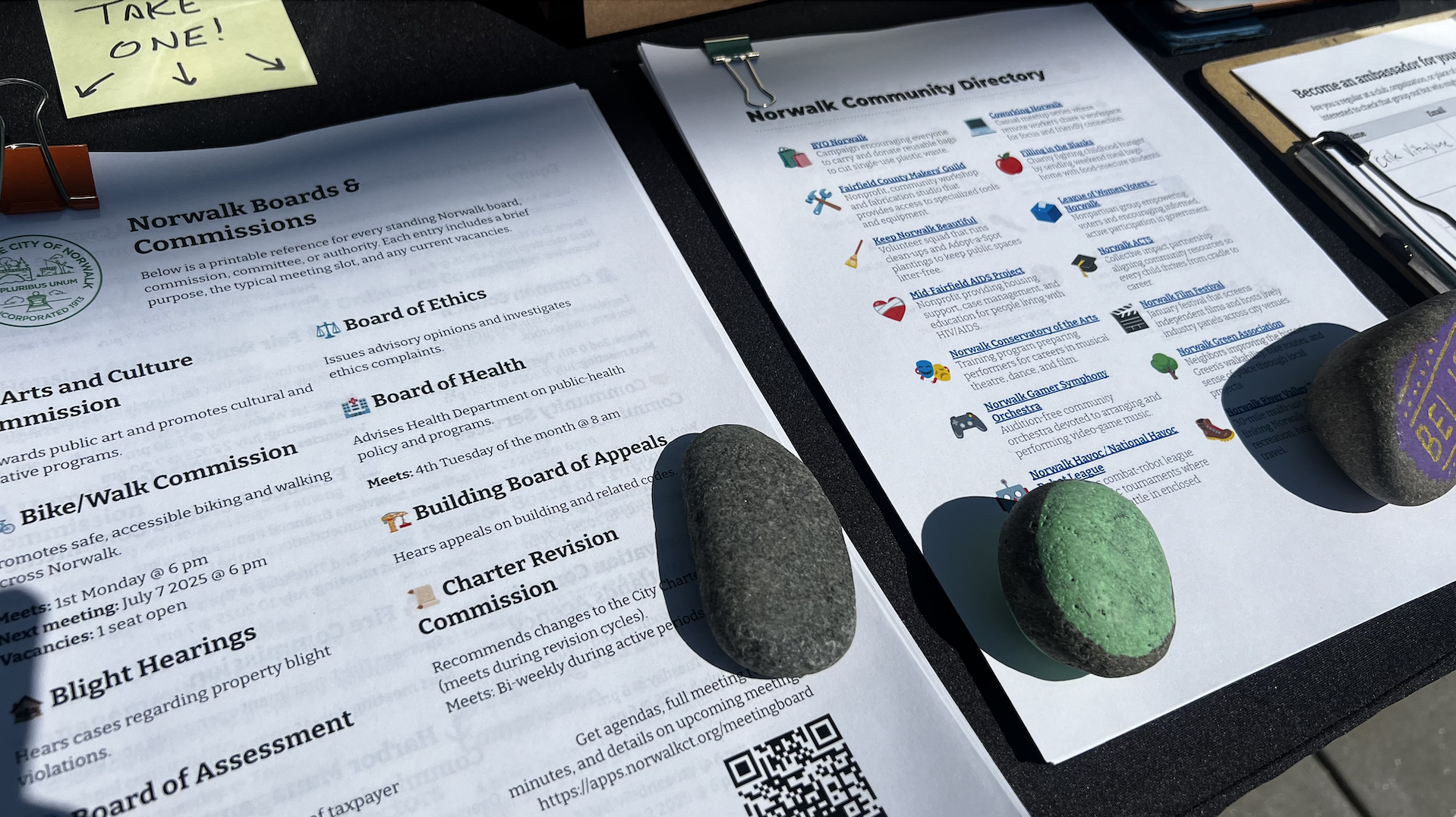
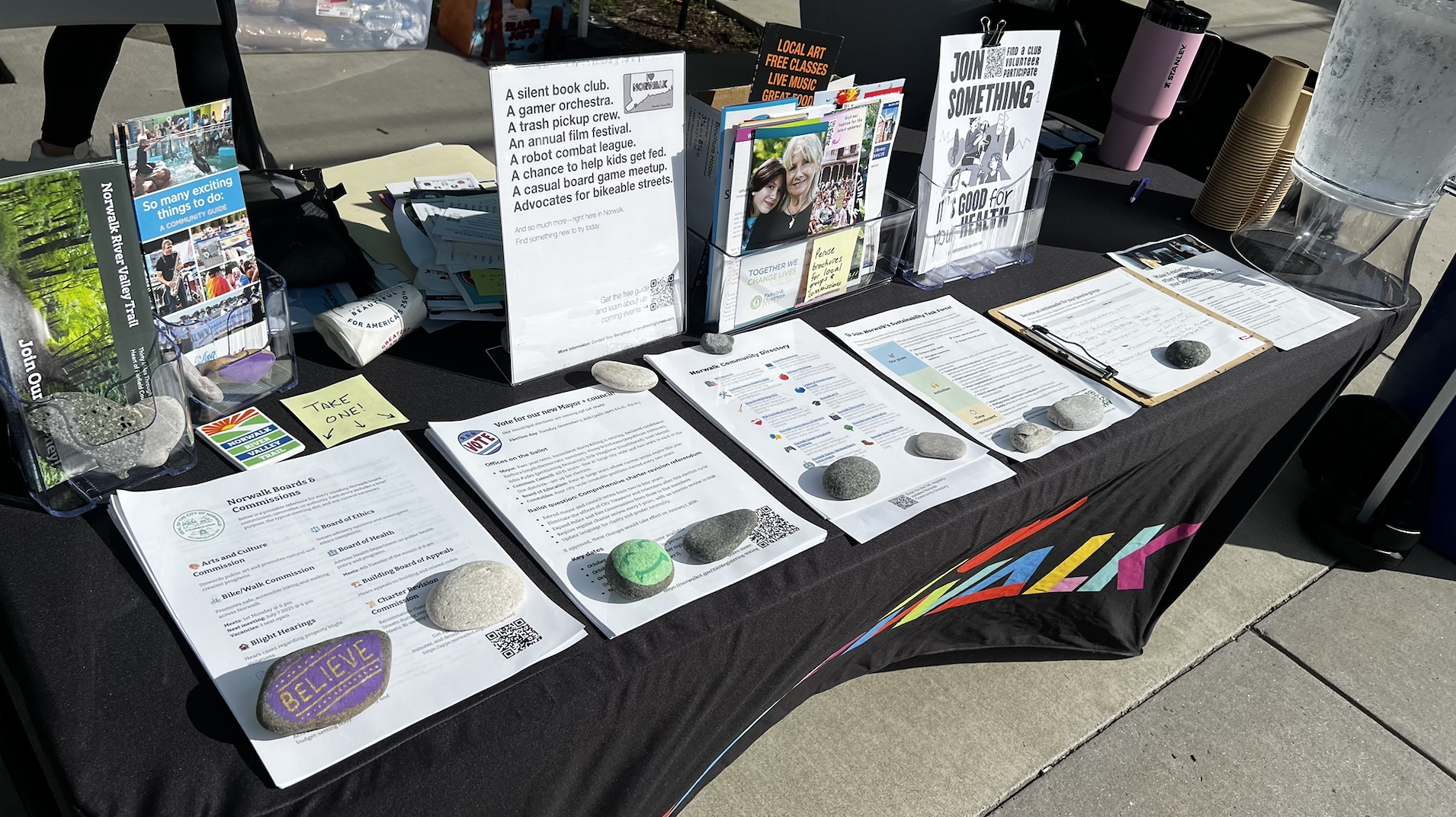
Pete: As Tony was building the directory, he was also honing his “New to Town Meetups,” which he kept hosting throughout the year.
Tony: The basic structure of it is first and foremost: We want to create a welcoming environment when people walk in the door. Especially this event is the kind of one that’s explicitly geared towards people who might be coming in by themselves, so we want to make sure we have a greeter at the door and we’ve got name tags.
We’d have some mingle time and then, once we settle everyone in, I welcome everyone, I tell them my story (“Hey, I’m pretty new to town”) and then I would have a brief round of intros. (Really, really, tight, unless we have above 30 or so, I might dial that back. I’m always also accounting for how many people show up. If five people show up or if 50 people show up, I’m going to run the same playbook a little bit differently.)
And so, once we’ve got everyone settled, everyone’s got a chance to say hi, I’ve lined up a couple of local people who are leaders of a particular thing who can talk (a) about the thing that they run, but (b) talk about all the other stuff that they know about and that they do and that they love about town.
And so I might have, you know, Tanner, who runs Sustainable Streets Norwalk, and he’ll talk about that organization, but he’s also gonna say, “well, I’m also a member of a food co-op, I also have a plot at the local farm,” so you’re creating all of this material for discussion and inspiration.
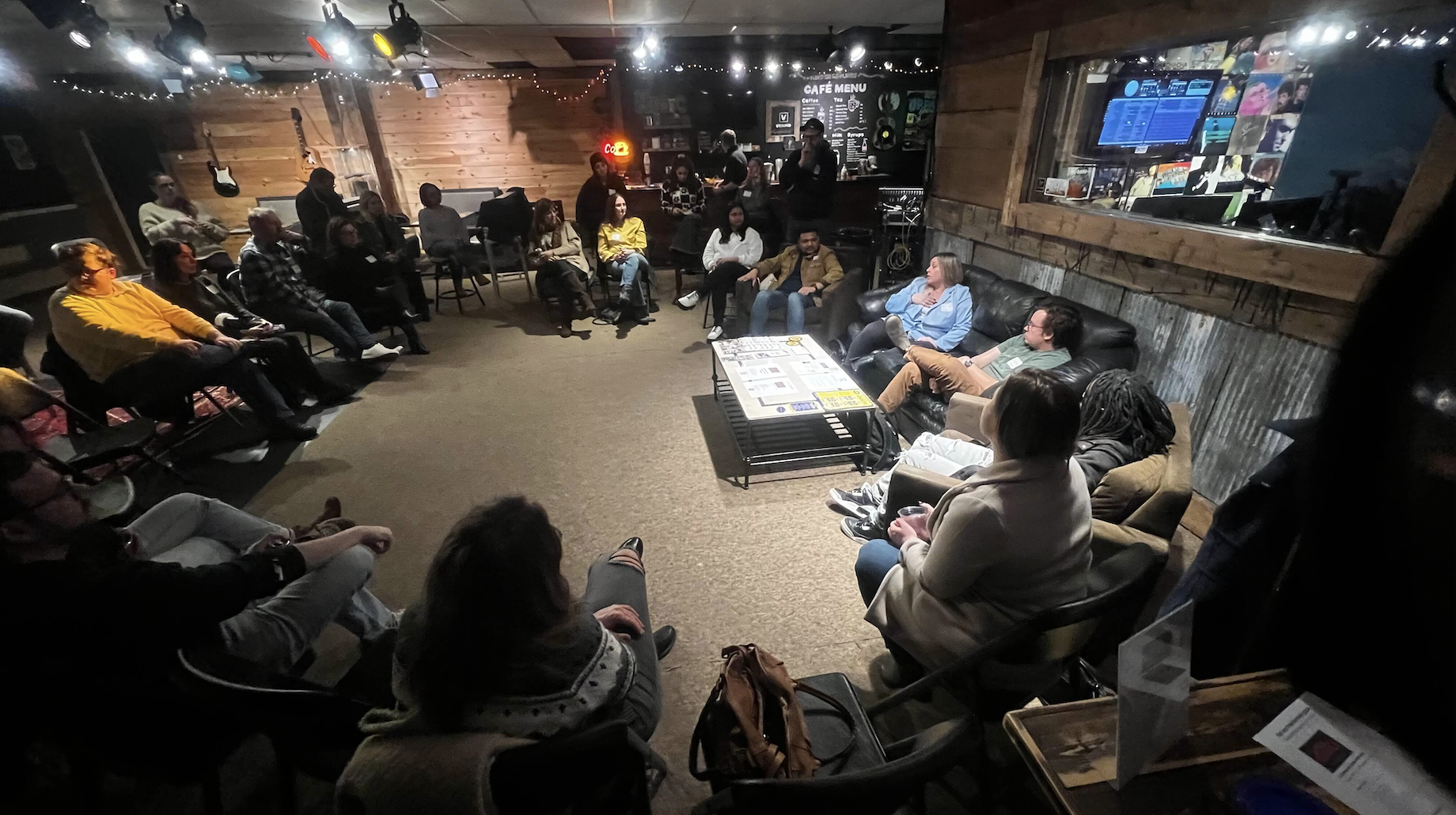
But then the third phase is open discussion: What do you wish you knew about? What do you wish was here? What are you still looking for? So that either someone else in the group can say, “Oh, I know that, let’s connect” or “Oh, I wish that existed too. Maybe we should create it.”
And then the last bit is: What’s something you’re doing that you want to invite other people to check out with you? And I always find this to be a great thing, really in any event, not even just this one. Where, if you end off with like “what’s something that you’re doing that you would love for other people to know about?” inevitably somebody shares something and other people are like, “Oh my God, that sounds great. I want to go to that, can I text you?” or whatever, and now you’re off to the races, right?
Rebecca: Because here’s what’s powerful about gathering and disseminating local information — the process of doing so is itself a community organizing project.
Tony: You can’t really do any kind of social thing unless you can physically take out your phone and text at least five people and say: “Hey, I’m thinking of doing this thing next Thursday at 10:00 AM, do you think you can join? I’d love to have you.”
And if you can’t do that, then you gotta get out and, you know, be a joiner and go check out other stuff until you reach that threshold. So the cool thing is: You can adopt that persona of being an explorer. Check stuff out, look for those flyers that are posted up on the community board, and be curious and be interested.
And then, once you start accumulating some of those people, then you can validate. You can say, “Look, I’m thinking about doing this event. Would you go to that? Would you help me run that?” And if you get three or four friends who are like, “Heck yeah, let’s do it. Let’s freaking do it,” then great, you’ve got a core of people. And if you do that event and only your core people show up, you’re still going to have a really good time. But now you’ve multiplied your capability, your reach multiplies, your skill sets multiply, your connections, all of that. You’re building organizational capacity.
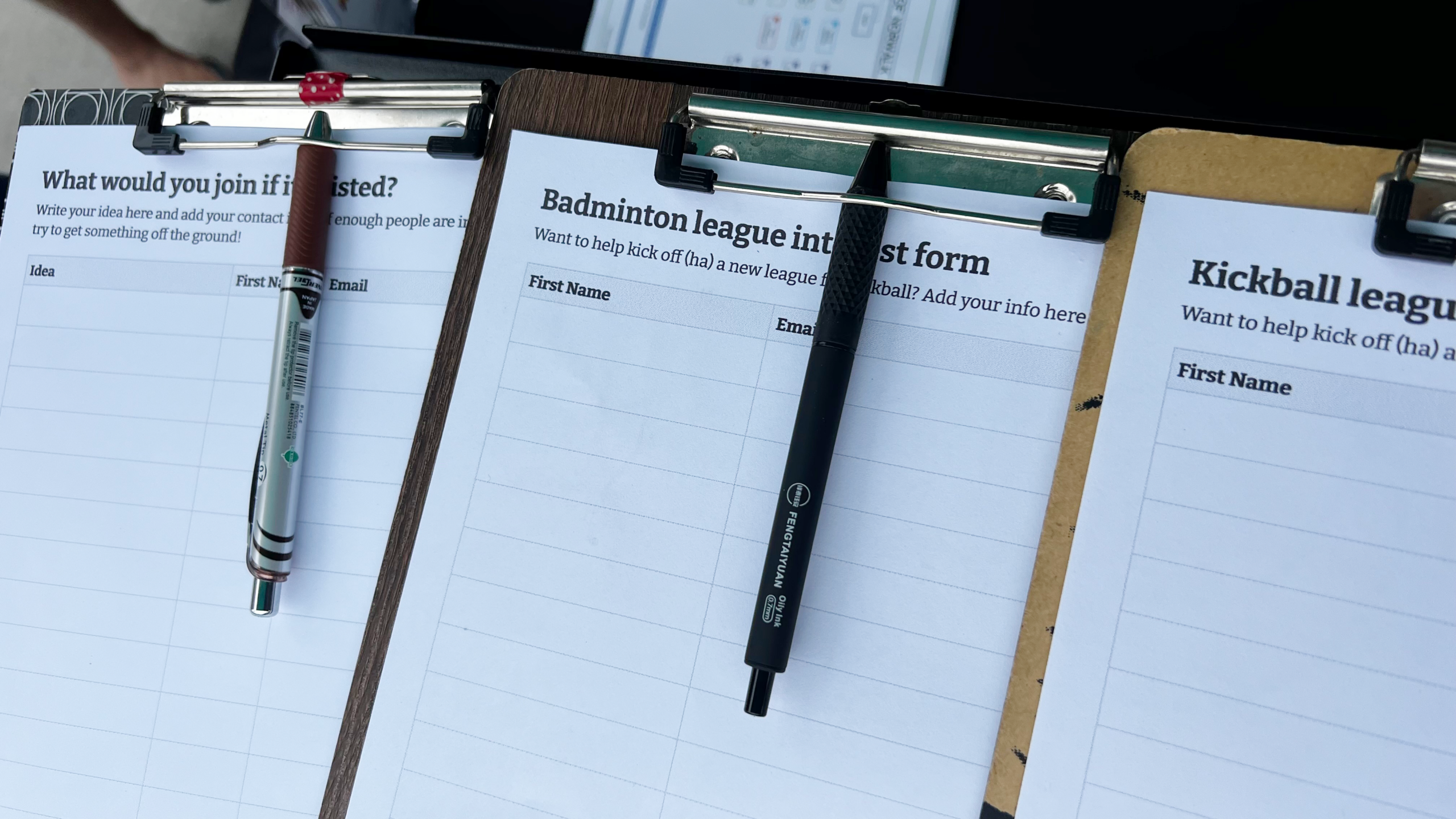
Ultimately, I want Norwalk to be an example that other cities try to follow because I think if we can set an example of what it looks like to really actively foster associational life as a mission, as a city, then maybe we can challenge other people in other cities to do the same thing. And maybe if enough of that happens, then we actually can make that upswing real.
Pete: Before we let Tony go, we had to ask him about one surprising club we saw in his directory:
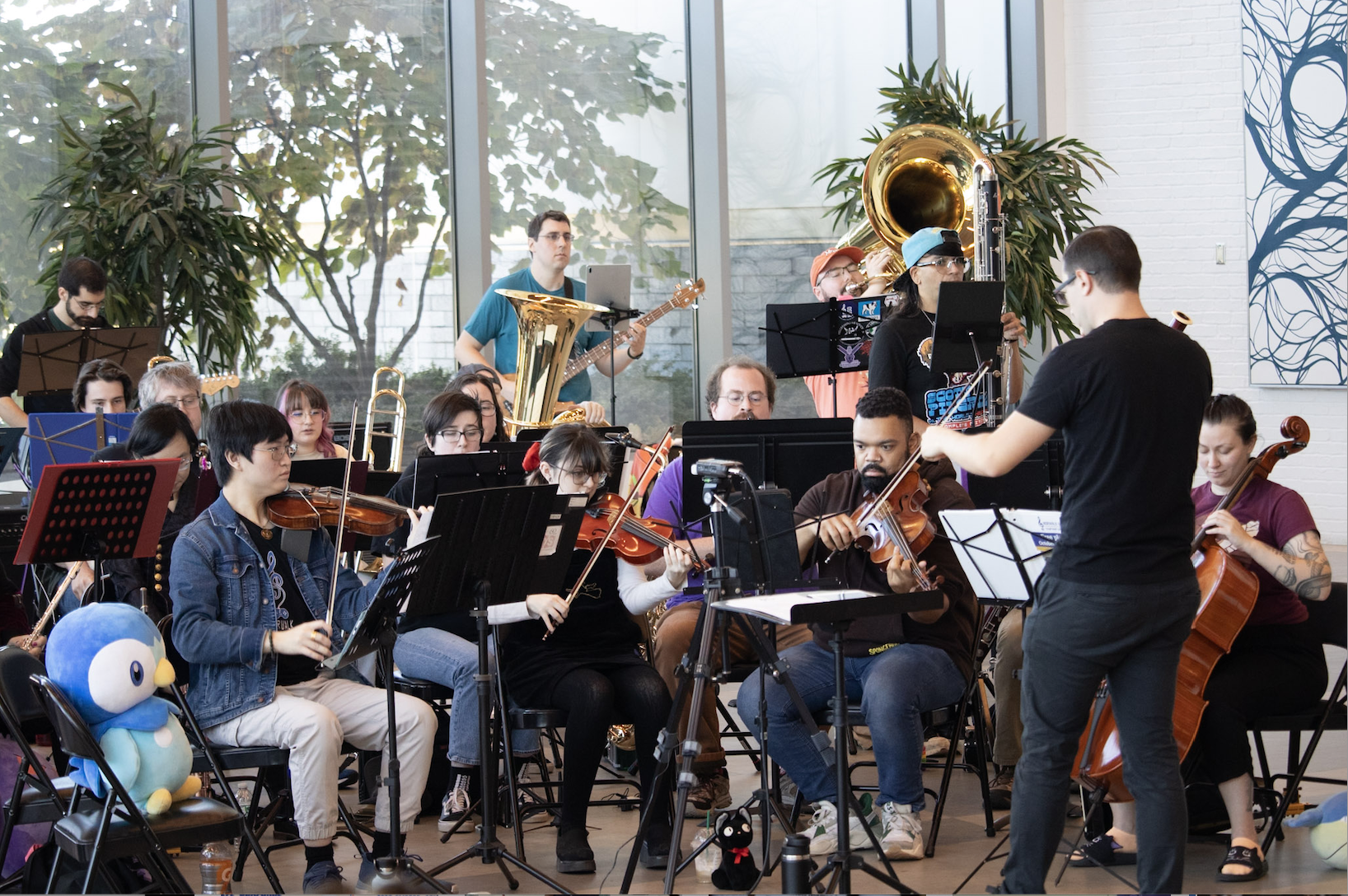
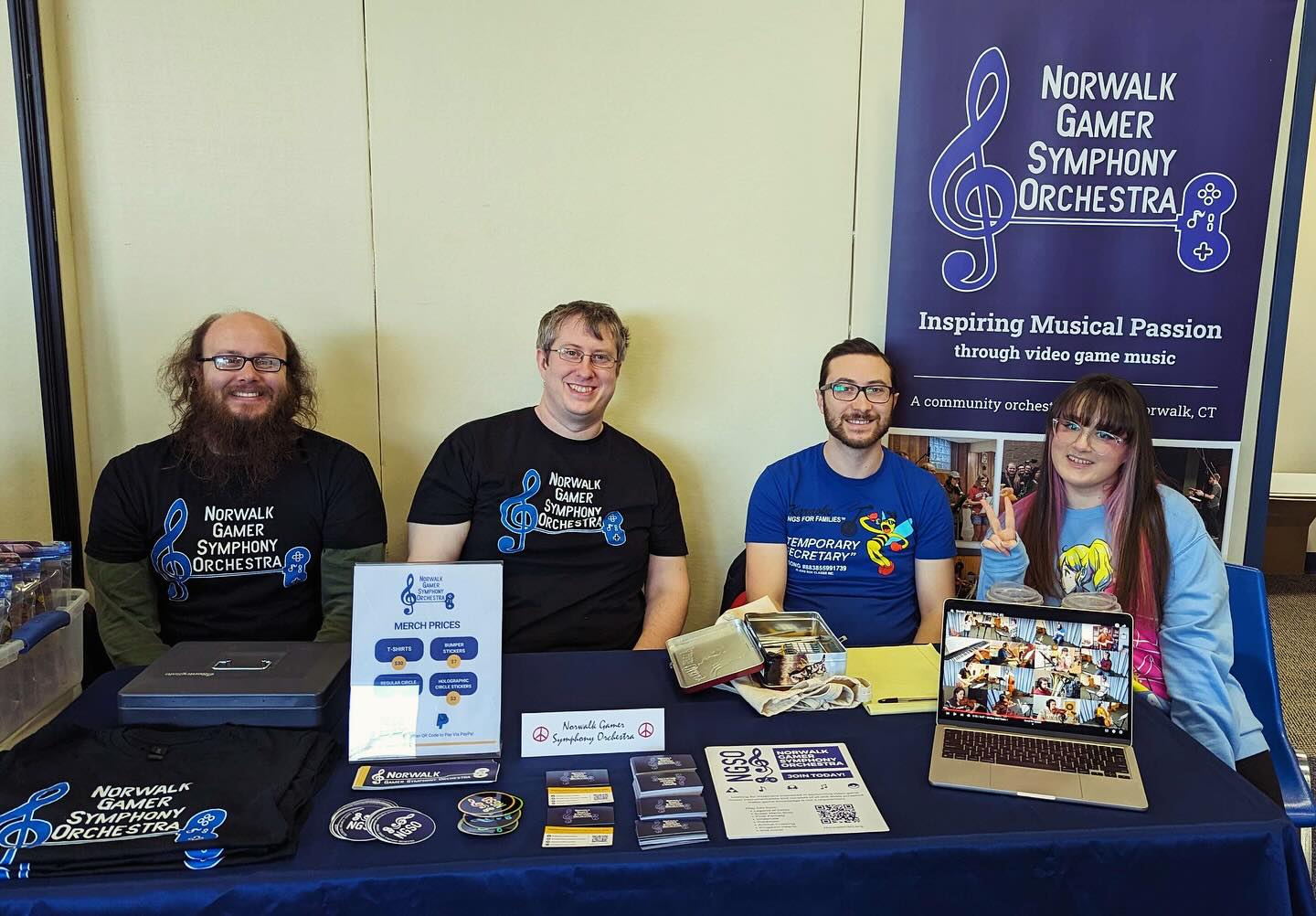
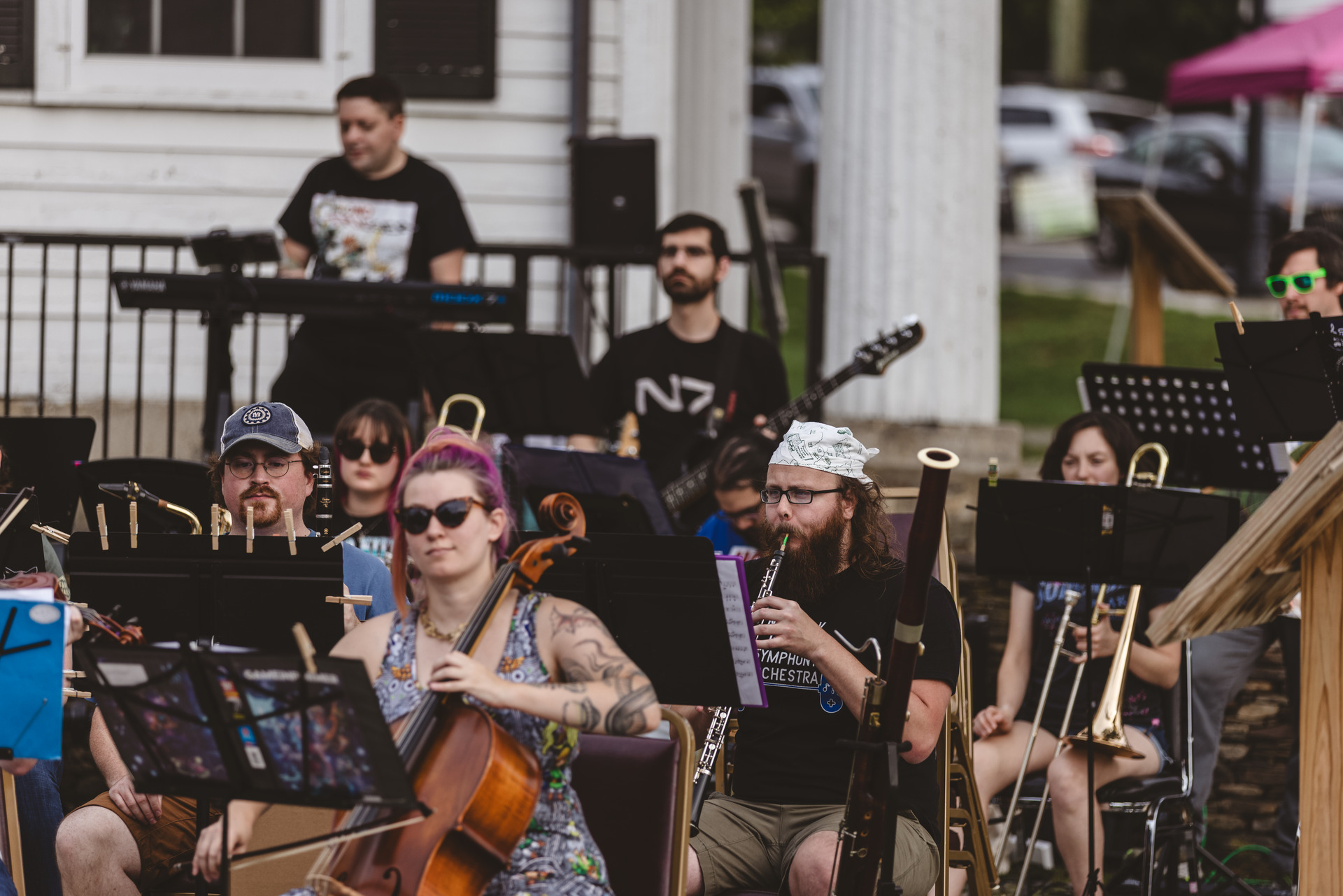
“You have to tell us about the Norwalk Gamer Symphony…”
Tony: Oh yeah, they’re wonderful, my friend’s in it. So it is a symphony orchestra, legit, great solid music, and all they play are video game songs. So they will play Final Fantasy, they’ll do Mario, like, they do a lot of obscure stuff, but they are phenomenal. They’re very, very, very, good…and you can imagine they have a hell of a lot of fun.
💡 Learn more
⇛ Read more from Tony about the process of creating a club directory in his LinkedIn post on Resurrecting the Club Directory
⇛ See the Norwalk Community Directory in it’s Google Doc form and find a template here to make your own
⇛ Learn more about running a “New in Town Meetup” in the New in Town Meetup: Organizers Guide
⇛ Follow Tony’s work at The Belongfulness Project and here on LinkedIn
🍿 Bring JOIN OR DIE to your community
Want to host a JOIN OR DIE screening with your community? Let us know using the button below and we’ll get in touch with more information about how to host: